
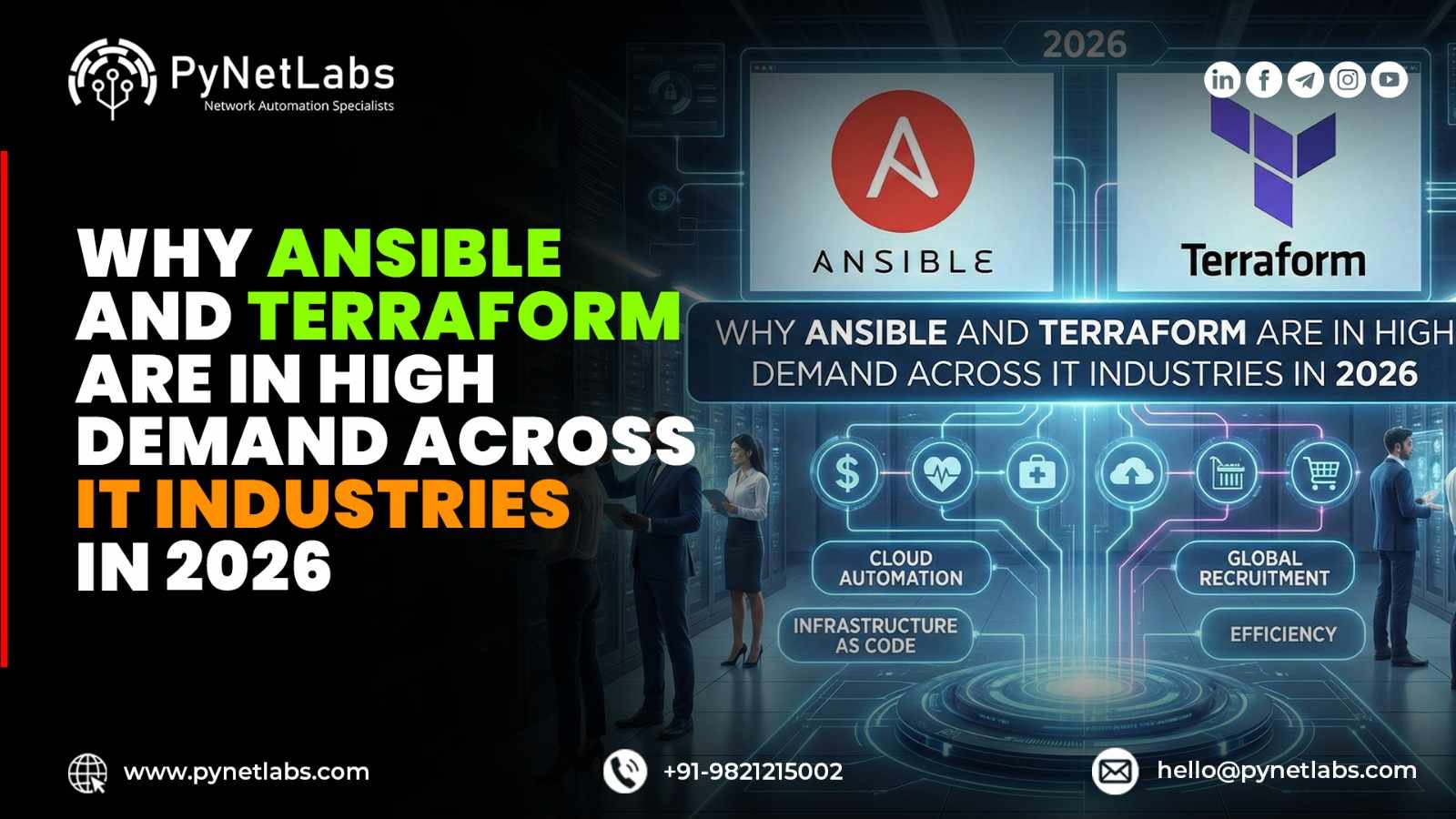
In today’s fast-evolving IT landscape, cloud automation has become an essential skill rather than a luxury. Organizations around the world are moving workloads to the cloud to manage infrastructure efficiently, reduce operational overhead, and ensure scalability. Manual processes cannot keep up with these demands, and errors caused by repetitive manual tasks can lead to downtime or security issues. This makes mastering an Ansible and Terraform Course a strategic step for IT professionals looking to optimize workflows, improve productivity, and manage cloud environments with confidence.
Whether you are a system administrator, network engineer, or aspiring DevOps professional, this course bridges the gap between theoretical knowledge and practical application. By offering hands-on exercises and real-world projects, learners gain the skills needed to provision infrastructure, automate configuration, deploy applications, and maintain secure, reliable cloud environments.
The Strategic Value of Cloud Automation
Cloud automation allows organizations to move beyond repetitive, error-prone tasks. By using scripts, configuration management tools, and infrastructure-as-code principles, IT teams can achieve efficiency, consistency, and agility across development, staging, and production environments.
A well-structured Ansible and Terraform Course teaches learners to approach infrastructure strategically. Rather than fixing problems one at a time, you define the infrastructure and its configuration in code. This code can be version-controlled, reused across multiple projects, and applied in different environments, ensuring consistency and reducing the risk of human error.
Automation also enables IT teams to focus on innovation and strategic initiatives. Routine provisioning, configuration, and deployment tasks can be completed quickly and reliably, freeing professionals to address higher-value projects and enhance overall productivity.
Terraform: Building Scalable Infrastructure
Terraform is widely recognized as one of the most powerful tools for provisioning cloud infrastructure. It allows you to define resources such as virtual machines, networks, storage, and databases in simple, readable configuration files.
Through an Ansible and Terraform Course, learners gain experience working with cloud providers such as AWS, Azure, and Google Cloud. They learn to manage dependencies between resources, handle variable configurations, and maintain Terraform state files, which track changes to infrastructure over time.
One of Terraform’s key strengths is its modularity. By creating reusable modules for common infrastructure components, such as web servers or databases, teams can deploy complex systems quickly and consistently. For example, a module for a multi-tier web application can be reused across development, staging, and production, ensuring identical configurations across environments. Hands-on labs provide learners with repeated practice in building, modifying, and destroying cloud environments, which builds confidence and prepares them for professional responsibilities.
Ansible: Ensuring Consistent Configuration
Provisioning infrastructure alone is not enough. Proper configuration and deployment are critical to ensuring that applications run reliably. Ansible automates server setup, software installation, and application deployment across multiple environments, reducing manual effort and minimizing the risk of configuration drift.
In an Ansible and Terraform Course, learners explore how to write YAML-based playbooks, manage dynamic inventories, and structure tasks efficiently. They gain the ability to create reusable roles and organize larger projects for scalable automation. For instance, deploying a multi-tier application with Ansible ensures that all web servers, databases, and caches are configured consistently, while Terraform manages the underlying infrastructure.
By combining Terraform and Ansible, learners can create an end-to-end automation pipeline where infrastructure provisioning and configuration happen seamlessly, mirroring workflows in enterprise DevOps environments.
Integrating Terraform and Ansible for Complete Automation
Modern cloud operations demand end-to-end automation. Integrating Terraform and Ansible enables teams to provision infrastructure and configure it in a single, streamlined workflow.
When Terraform creates a set of virtual machines, Ansible can automatically configure them, install software, and deploy applications. This reduces human error, accelerates deployment timelines, and ensures consistency across all environments. Beyond deployment, learners also practice troubleshooting automation workflows, managing dependencies, and optimizing configurations for performance and reliability.
By understanding how these tools complement each other, professionals develop the ability to design scalable, resilient automation pipelines that mirror enterprise practices.
Managing Multi-Environment Deployments
Organizations often operate multiple cloud environments, including development, staging, and production. A comprehensive Ansible and Terraform Course teaches learners to manage these environments efficiently.
Participants learn to parameterize configurations for different stages, securely manage secrets, and maintain consistent deployment pipelines without duplicating code. Deployments can be tested in development, refined in staging, and promoted to production with minimal risk of human error. This approach ensures that applications behave consistently and reliably across all environments. Security and governance are integral, including managing credentials safely, implementing role-based access controls, and designing modular, maintainable automation scripts.
Hands-On Projects: Real-World Learning
Practical experience is the cornerstone of mastering cloud automation. Learners work on real-world projects, such as deploying multi-tier applications, setting up automated CI/CD pipelines, and managing dynamic cloud environments.
Institutes like PyNet Labs emphasize lab-based exercises that simulate enterprise scenarios. This hands-on approach reinforces theoretical knowledge and builds confidence in tackling professional challenges. Students gain experience troubleshooting errors, interpreting execution plans, and applying solutions in environments that mirror production-level complexities. This real-world exposure ensures that learners can transition smoothly into professional roles.
Security and Best Practices in Automation
Automation is only effective if it is secure. An Ansible and Terraform Course equips learners with best practices for building secure and compliant automated systems. Students learn how to manage sensitive credentials, implement access controls, and write modular, maintainable code.
Security-focused training ensures that automated workflows are resilient against misconfigurations that could expose vulnerabilities. Maintaining secure pipelines is especially critical in enterprise environments, where compliance with organizational policies and regulatory standards is non-negotiable.
Troubleshooting and Optimization
Even the most carefully designed automation pipelines can encounter challenges. A strong course emphasizes troubleshooting and optimization skills. Learners gain expertise in diagnosing failed deployments, interpreting Terraform execution plans, and refining Ansible playbooks to improve efficiency.
By practicing problem-solving in controlled lab environments, professionals develop confidence in handling real-world issues. These skills are invaluable in production, where downtime can be costly, and rapid resolution is critical to maintaining service reliability.
Career Opportunities with Cloud Automation Skills
Mastering cloud automation with Ansible and Terraform opens doors to high-demand career paths. Professionals are sought after for roles such as DevOps Engineer, Cloud Engineer, Infrastructure Automation Specialist, and Site Reliability Engineer.
Beyond job titles, the ability to design and maintain automated cloud environments enhances your value to IT teams. Professionals skilled in automation can improve operational efficiency, reduce downtime, and contribute to strategic initiatives, making them integral to business growth.
Conclusion
An Ansible and Terraform Course goes far beyond learning commands or syntax. It provides the knowledge and practical skills to provision infrastructure, automate configurations, deploy applications, and manage cloud environments efficiently. By mastering these tools, IT professionals gain the confidence to handle enterprise-level projects, optimize workflows, and contribute meaningfully to any IT organization.





Write a comment ...